Stadiums and arenas depend on a distributed antenna system (DAS) to carry mobile coverage from the carriers to every seat, concourse and suite, so tens of thousands of fans can stream, post and call at the same time. On game day, that system earns every watt it draws.
Then the lights go off. The gates lock. Seventy thousand seats sit empty. And in the headend room, the DAS keeps burning full power—every amplifier, every band, every zone—as if kickoff were in ten minutes.
It will do that tonight. And tomorrow night. And on nearly every other non-event day of the year.
The in-building wireless industry rarely talks about this. It talks about capacity, about 5G, about how many gigabits per fan a network can deliver on game day. It rarely talks about the power bill for every other day—even though most of a large-venue DAS runs at full power while the building is dark.
That is starting to change, because the people who pay the bill—the mobile network operators—have started asking why.
Legacy DAS can't sleep
Legacy DAS architectures keep the carriers' radios—remote radio heads (RRHs)—in the headend, feeding their RF through analog interface equipment out to remote units and amplifiers at hundreds of antenna locations. Each one draws full power around the clock, whether 70,000 fans are in the bowl or none. You can't selectively sleep a system designed around always-on RF hardware.
That equation has already changed once. All-digital headend interfaces—direct digital connections into the carrier's baseband units—removed the RRHs and the analog signal chain from the headend entirely, sharply reducing headend power. But that was only the first saving. The next step powers remotes only when they're needed. In a digital DAS, power becomes a software problem—and software problems can be scheduled.
Proven, not promised: 700 A off the DC plant
At the request of Tier-1 US carriers, ANDREW built scheduled power management—sleep mode—into ERA® DAS, our all-digital platform. It can power down amplifiers and remotes by frequency band, by zone and on a schedule—while overlapping coverage keeps the venue connected.
Together with a Tier-1 carrier, we proved it in a four-phase trial at a major US stadium. Each phase went further than the last. Phase one powered down the advanced wireless services (AWS) and personal communications service (PCS) amplifiers during the overnight maintenance window. Phase two added the 850 MHz band. Phase three shut down remotes in selected zones with overlapping coverage on non-event days. Phase four, the aggressive case, powered down the entire seating bowl while the concourses stayed covered (Figure 1).
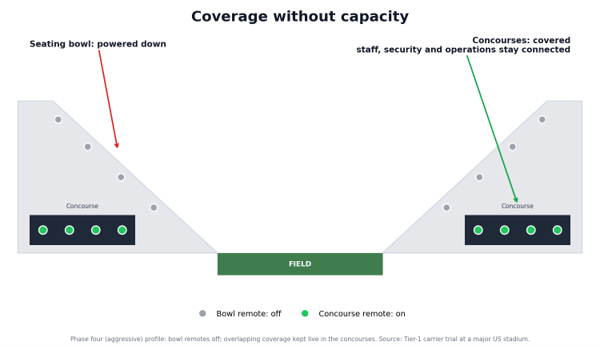
Figure 1—Coverage without capacity: the aggressive phase keeps the concourses connected while the seating bowl is powered down.
The measured result: about 700 A less load on the DC power plant. On a non-event day, sleep mode turns an always-on load into one that follows the venue's calendar (Figure 2). Extrapolated, the trial maps to an illustrative $50,000 a year in energy savings at a single venue. The real number depends on how deep the operator chooses to go. The point is the knob exists, and it turns.
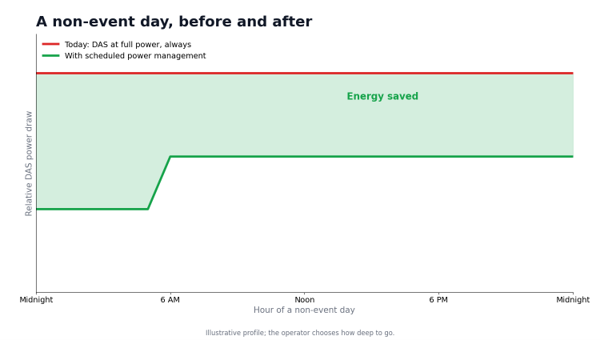
Figure 2—A non-event day, before and after: illustrative DAS power draw with and without scheduled power management.
And one venue is only the start. Carriers run DAS in many stadiums and arenas, so the savings multiply across multiple venues.
Why carriers—and venues—care
Two reasons, and neither is mysterious. The first is operating expense (OPEX): energy is a cost that never stops in a large-venue network, and carriers operate many of these buildings. The second is environmental, social and governance (ESG) commitments: major operators have public carbon and energy-efficiency targets, and a full-power DAS in an empty stadium is hard to defend in a sustainability report. Venues gain too: less load on building power and cooling, and a concrete step toward their own sustainability goals.
Put power on the requirements list
For twenty years, DAS innovation has meant more: more bands, more capacity, more throughput. Power was somebody else's problem—a line in the operating budget, never a product feature.
Now power belongs on that list. As carriers look harder at operating cost and carbon targets, energy efficiency deserves a place next to coverage and capacity when choosing a DAS. Before your next large-venue build, ask three questions: Can the DAS power down by band? By zone? On a schedule?
A stadium doesn't need to burn full power every day of the year to be ready on game day. The trial proved it. The knob exists, and it is ready to turn.
See what scheduled power management could save across your venues. Contact the ANDREW in-building team through our stadiums and arenas page to start the conversation.
Author
